> For the complete documentation index, see [llms.txt](https://docs.inverse.finance/inverse-finance/llms.txt). Markdown versions of documentation pages are available by appending `.md` to page URLs; this page is available as [Markdown](https://docs.inverse.finance/inverse-finance/inverse-finance/products/dola-feds.md).
# DOLA Feds
DOLA Supply Management
Fed contracts are specialized smart contracts that manage DOLA supply across different protocols and liquidity venues. Each Fed has the authority to mint new DOLA (expansion) or burn existing DOLA (contraction), allowing the protocol to adjust circulating supply in response to market demand. The name "Fed" draws inspiration from central banks like the U.S. Federal Reserve, but with a critical difference — Inverse Finance Feds operate transparently on-chain under DAO governance control, with every expansion and contraction visible in real-time.
Feds serve two primary functions: providing DOLA supply where it's needed (lending markets, liquidity pools, stability modules) and maintaining DOLA's $1 peg through supply adjustments. Rather than requiring the DAO to manually mint and distribute DOLA across various venues, Feds automate this process within governance-approved parameters, allowing the Fed Chair to respond quickly to market conditions while maintaining accountability through on-chain transparency.
***
### How Feds Work
All Fed contracts share core functionality regardless of their specific deployment venue. Each Fed can expand DOLA supply by minting new DOLA and supplying it directly to its connected protocol (a lending market, liquidity pool, or stability module). When contraction is needed, the Fed withdraws DOLA from the protocol and burns it, permanently removing it from circulation.
These operations are controlled by the Fed Chair multisig, which can execute expansions and contractions within parameters set by governance, but cannot exceed globally approved limits or violate risk constraints established by the Risk Working Group. This creates a balance between operational flexibility (the Fed Chair can respond to market conditions in hours, not days) and decentralized control (the DAO sets the boundaries within which Feds operate).
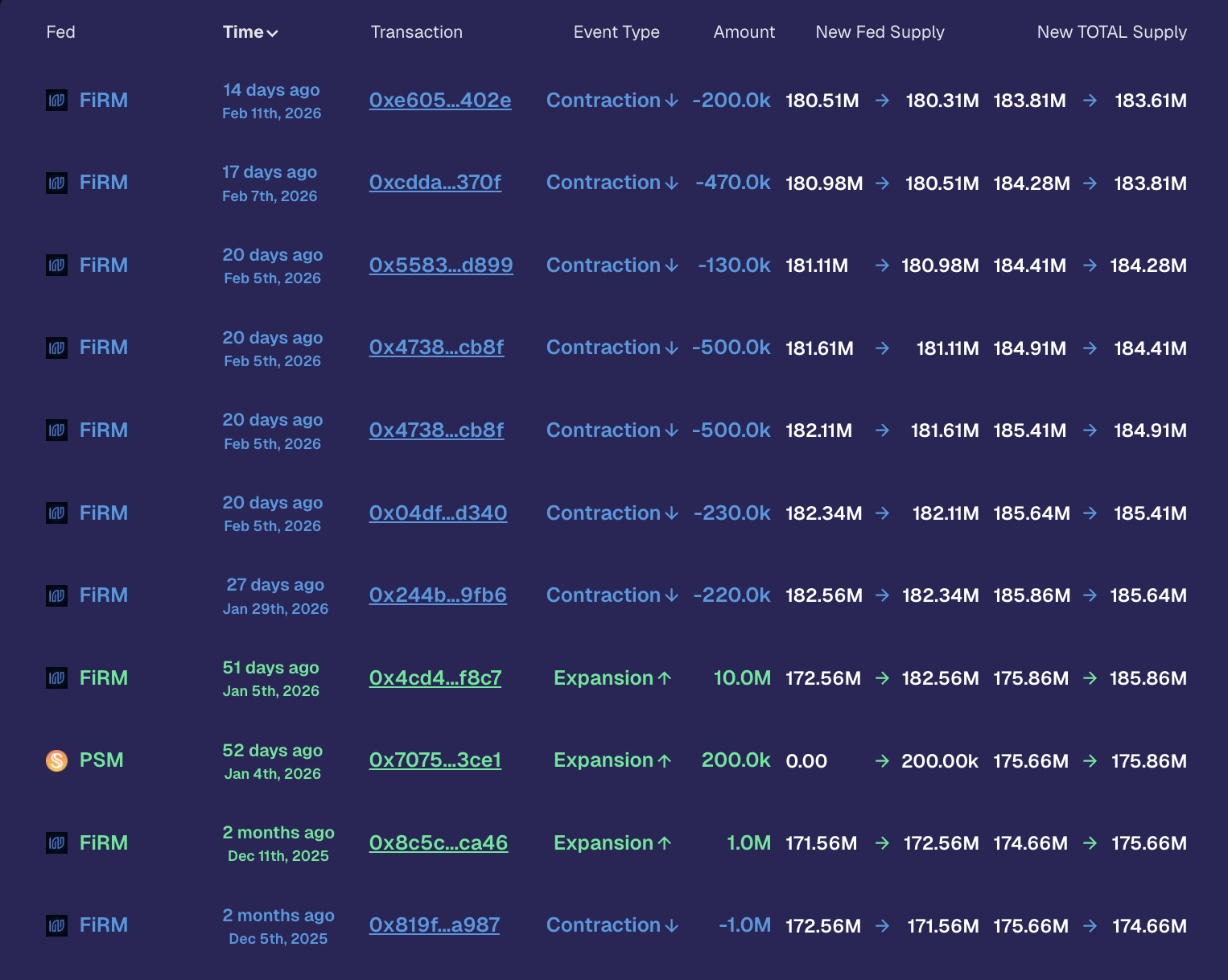
Every Fed operation is recorded on-chain and visible through the transparency portal. When the FiRM Fed expands by 1M DOLA to increase lending capacity, that transaction appears in the [Feds Policy page](https://www.inverse.finance/transparency/feds) with the exact timestamp, amount, and resulting total supply. When the PSM Fed contracts by withdrawing DOLA, the transaction is similarly logged. This transparency ensures the community can audit Fed behavior and verify that operations align with stated peg management goals.
***
### Active Fed Contracts
The DAO currently operates three Fed contracts, each serving a distinct role in the DOLA ecosystem.
#### FiRM Fed (Isolated-Lending)
The FiRM Fed is DOLA's primary supply source, providing nearly all circulating DOLA through overcollateralized lending on FiRM's fixed-rate markets. When users deposit approved collateral types (wstETH, wBTC, sUSDe, INV, etc.) and borrow DOLA, that DOLA is minted by the FiRM Fed and backed by the borrower's collateral position.
The Fed maintains both a global DOLA limit (the maximum total DOLA that can be borrowed across all FiRM markets) and per-market limits. These limits are set by governance based on risk assessments and recommendations driven by the RWG. For example, if a particular market shows signs of stress or the collateral becomes more volatile, the RWG may recommend reducing that market's daily borrow limit or market ceiling.
#### Frontier Fed (Cross-Lending)
The Frontier Fed represents a legacy Fed tied to the now-deprecated Frontier variable-rate lending protocol. Frontier was Inverse Finance's original lending product, launched in 2021, but was sunsetted in favor of FiRM's superior fixed-rate model and enhanced security features following the April 2022 exploit.
While no new DOLA can be borrowed through Frontier, existing unbacked borrows remain outstanding. The Frontier Fed will gradually shrink over time as proceeds from other products owned by the Inverse Finance DAO repay this bad debt.
#### PSM Fed (Peg Stability Module)
The PSM Fed operates the Peg Stability Module, which enables direct 1:1 swaps between DOLA and approved stablecoins (currently USDS via integration with ERC4626 vaults). The PSM serves dual purposes: peg defense during stress periods and immediate liquidity provision for FiRM liquidators.
The PSM's small size relative to total DOLA supply reflects its role as a backstop mechanism rather than a primary supply source. It exists to provide peg defense during stress events and ensure liquidators have access to DOLA when needed, not to supply the majority of DOLA in normal market conditions.
The PSM represents the evolution of Inverse Finance's original DOLA Stabilizer (launched February 2021), which facilitated 1:1 DOLA-DAI swaps. The Stabilizer was deprecated in October 2023 as AMM Feds and FiRM made it redundant, but the need for immediate DOLA liquidity during liquidations persisted. The PSM addresses the Stabilizer's limitations while adding flexibility, yield generation on reserves, and extensibility for future peg defense mechanisms.
***
### Historical Context: AMM Feds
Before FiRM became DOLA's dominant supply source, the protocol relied heavily on AMM Feds (Automated Market Maker Feds) that managed DOLA supply in decentralized exchange liquidity pools. These Feds would mint DOLA and deposit it into Curve, Balancer, Velodrome, Aerodrome pools alongside counterparty assets (USDC, FRAX, etc.), receiving LP tokens representing the Fed's share of the pool.
When demand for DOLA increased (users swapping into DOLA or depositing counterparty assets), the AMM Fed would expand by minting additional DOLA to rebalance the pool. When demand decreased (users swapping out of DOLA), the Fed would contract by withdrawing and burning excess DOLA. The Fed's DOLA was effectively backed by the counterparty assets in the pool — if the Fed supplied 1M DOLA to a DOLA-USDC pool, it received LP tokens representing both the DOLA and an equivalent amount of USDC.
This model worked but had limitations compared to the current FiRM-dominated approach. Capital efficiency was lower, peg management required more active intervention, and the backing structure was more complex. Most importantly, AMM Feds created DOLA supply without creating corresponding DOLA demand — the DOLA was just liquidity, not productive borrowing.
Most AMM Feds have been deprecated, with DOLA liquidity now maintained through organic and/or incentivized liquidity provision rather than through Fed-managed positions.
***
### Monitoring Fed Operations
Fed activity is fully transparent and can be monitored in real-time through the transparency portal. The [Feds Policy page](https://www.inverse.finance/transparency/feds) shows every expansion and contraction transaction across all Fed contracts, including:
* Transaction hash (linking to Etherscan for full details)
* Event type (Expansion or Contraction)
* Amount of DOLA minted or burned
* New Fed supply after the transaction
* New total supply across all Feds
* Timestamp
***
### Resources
* **Fed Operations:** [Transparency - Feds Policy](https://www.inverse.finance/transparency/feds)
* **DOLA Supply Breakdown:** [Transparency - DOLA & Feds](https://www.inverse.finance/transparency/dola)
---
# Agent Instructions
This documentation is published with GitBook. GitBook is the documentation platform designed so that both humans and AI agents can read, navigate, and reason over technical content effectively. Learn more at gitbook.com.
## Querying This Documentation
If you need additional information that is not directly available in this page, you can query the documentation by asking a question.
Perform an HTTP GET request on the following URL with the `ask` and `goal` query parameters:
```
GET https://docs.inverse.finance/inverse-finance/inverse-finance/products/dola-feds.md?ask=&goal=
```
`ask` is the immediate question: it should be specific, self-contained, and written in natural language.
`goal` is what the user is ultimately trying to achieve, the reason they need the answer. Sharing it helps GitBook give you a better, more relevant answer. A goal is most helpful when it describes the outcome the user wants rather than restating the question. For example, with `ask=how do I create an API token`, a goal like `automate deployments from our CI pipeline` lets GitBook tailor the answer to that use case.
The response will contain a direct answer to the question and relevant excerpts and sources from the documentation.
Use this mechanism when the answer is not explicitly present in the current page, you need clarification or additional context, or you want to retrieve related documentation sections.